Cadaveric Surgical Skills Course

Primary Total KneeReplacement

Surgical Skills Workshop for Practicing Orthopaedic Surgeons

A full-day fresh-frozen cadaveric workshop for surgeons seeking to refine and expand their technical skills in primary total knee replacement. Focused lectures are paired with three progressive laboratory modules — from exposure and bone preparation through balancing, cementing and closure — with real-time faculty feedback at every station.
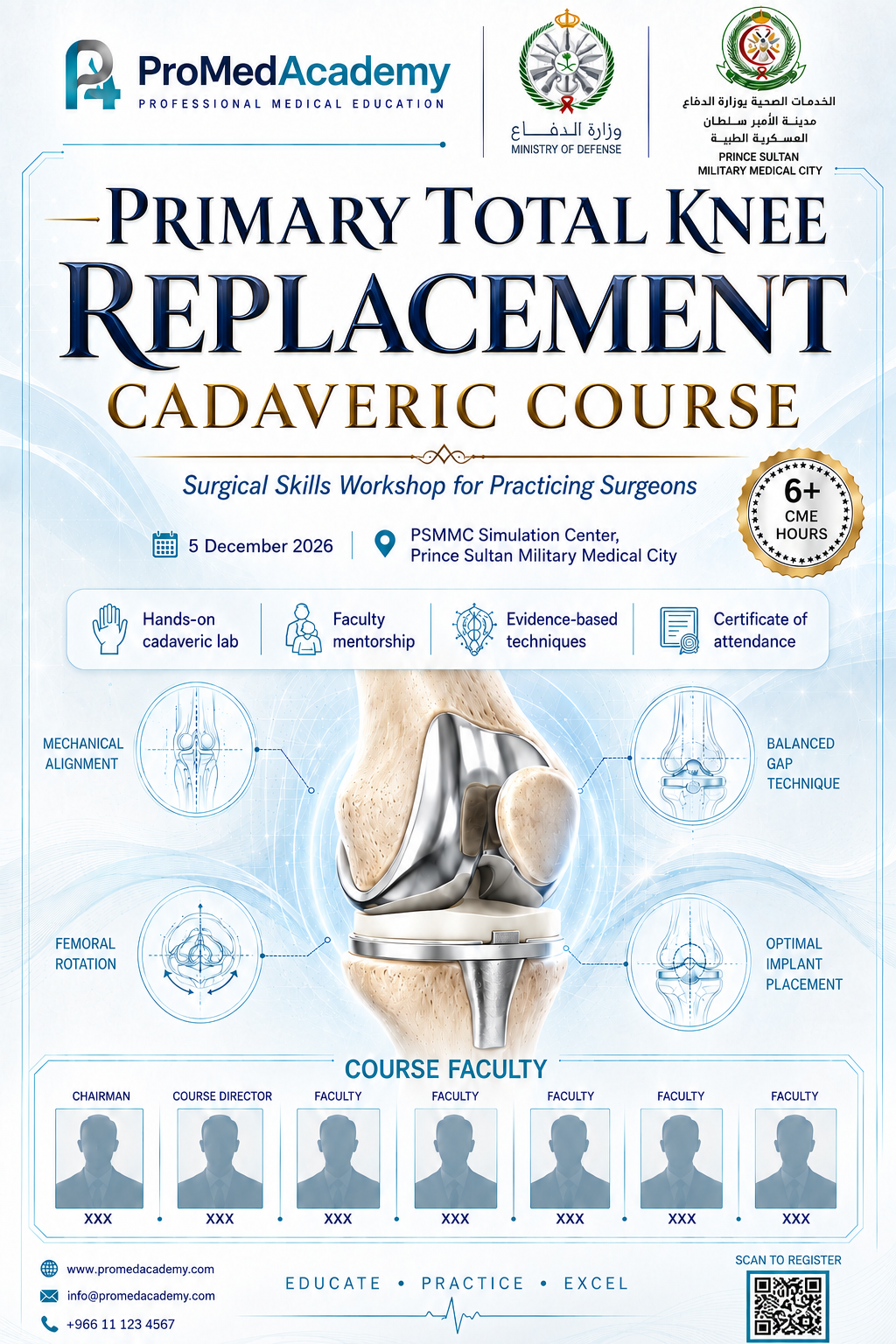
Primary Total Knee Replacement cadaveric surgical skills course poster
270 Min Hands-On
📅5 December 2026 · 07:00 – 17:50
📍Prince Sultan Military Medical City — Simulation Center, Riyadh
🏆6+ CME Hours
About the Course

Precision, Repetition and Faculty-Guided Practice

This full-day cadaveric workshop is designed for practicing orthopaedic surgeons seeking to refine and expand their technical skills in primary total knee replacement. Focused lectures are paired with extensive hands-on laboratory sessions so participants can revisit foundational principles, apply contemporary techniques and receive real-time faculty feedback in a controlled learning environment.

Hosted at the Prince Sultan Military Medical City Simulation Center in Riyadh, the programme runs one faculty mentor for every two participants across three progressive laboratory modules — 270 minutes of structured cadaveric time covering exposure, bone cuts, trial reduction, balancing, implantation, cementing and layered closure.

"Revisit the foundations, then rebuild the technique step by step — every cut, every gap and every component check under direct faculty supervision."
1
Full Day
270
Minutes Hands-On
3
Lab Modules
1:2
Faculty to Participants
Curriculum

Key Surgical Topics

🦴
Surgical Anatomy & Landmarks

Key bony and soft-tissue landmarks of the knee, exposure pitfalls, and the anatomy that governs safe resection.

📐
Alignment Philosophies

Knee biomechanics and the selection of mechanical, kinematic or functional alignment strategies.

🖥️
Preoperative Planning

Radiographic assessment, structured implant selection and building an alignment plan before the first cut.

⚙️
Resection & Balancing

Tibial and femoral resections, sizing and rotation, trial reduction, gap assessment and soft-tissue releases.

🧪
Cementing & Implantation

Bone preparation, cement mixing and pressurisation, component seating, insert locking and layered closure.

🛡️
Complications & Technology

Periprosthetic joint infection, intraoperative salvage, robotic assistance, navigation and ERAS protocols.

Course Features

A Fresh-Frozen Cadaveric Experience

  • 01

    One Faculty per Two Participants

    A 1:2 mentoring ratio in the laboratory means direct, real-time feedback on cutting accuracy, balancing and component positioning.

  • 02

    Three Progressive Modules

    270 minutes of structured cadaveric time that carries the same specimen from exposure through to final closure.

  • 03

    Decision-Making & Complications

    Practical strategies for component revision, bone deficiency, malalignment and soft-tissue compromise, reinforced by a dedicated complications panel.

  • 04

    Technology & Innovation

    Robotic assistance, computer navigation and patient-specific instrumentation discussed alongside the alignment strategy that drives them.

Program

Full-Day Course Agenda

Morning · Foundations & Laboratory Modules 1–2Saturday, 5 December 2026 · 07:00 – 13:05
07:00 – 07:30
Registration & Welcome Coffee
Networking
07:30 – 08:00
Welcome Address & Course Overview
Lecture
08:00 – 08:30
Surgical Anatomy of the Knee: Landmarks & Pitfalls
Lecture / Q&A
08:30 – 09:00
Knee Biomechanics & Alignment Philosophies: Mechanical vs. Kinematic vs. Functional
Lecture
09:00 – 09:30
Preoperative Planning, Radiographic Assessment & Implant Selection
Lecture / Case Discussion
09:30 – 09:45
Coffee Break
Break
09:45 – 11:15
Cadaveric Lab — Module 1: Exposure, Tibial & Femoral Bone Preparation
Hands-On Lab
11:15 – 11:35
Module 1 Debrief: Cutting Errors, Rotational Alignment & Common Pitfalls
Debrief / Discussion
11:35 – 13:05
Cadaveric Lab — Module 2: Trial Reduction, Gap Balancing & Soft-Tissue Management
Hands-On Lab
Afternoon · Implantation, Complications & TechnologySaturday, 5 December 2026 · 13:05 – 17:50
13:05 – 13:50
Lunch & Invited Faculty Presentation: Outcomes Data in Primary TKR — What the Evidence Shows
Lecture / Networking
13:50 – 14:20
Periprosthetic Joint Infection: Prevention, Diagnosis & Management
Lecture
14:20 – 15:50
Cadaveric Lab — Module 3: Final Implantation, Cementing Technique & Closure
Hands-On Lab
15:50 – 16:05
Coffee Break
Break
16:05 – 16:35
Complications Panel: Intraoperative & Early Postoperative Recognition, Avoidance & Salvage
Panel Discussion
16:35 – 17:05
Emerging Technologies: Robotic-Assisted Surgery, Navigation & Patient-Specific Instrumentation
Lecture
17:05 – 17:25
Enhanced Recovery After Surgery (ERAS) Protocols in TKR: Perioperative Optimisation
Lecture
17:25 – 17:50
Wrap-Up, Q&A & Certificate Distribution
Plenary
Hands-On Curriculum

Three Progressive Laboratory Modules

1️⃣
Exposure & Bone Preparation

09:45 – 11:15 · 90 minutes

· Positioning, limb preparation and tourniquet application
· Incision planning and medial parapatellar arthrotomy
· Synovectomy, osteophyte removal and cruciate management
· Tibial resection: slope, level and coronal alignment
· Distal femoral resection: angle and depth
· Femoral sizing, anterior/posterior and chamfer cuts

2️⃣
Trial Reduction & Soft-Tissue Balancing

11:35 – 13:05 · 90 minutes

· Insertion of tibial and femoral trials
· Flexion-extension gap assessment
· Medial and lateral release techniques
· Patellar sizing, resection and component selection
· Patellar tracking and the no-thumb test
· Final range of motion and stability assessment

3️⃣
Implantation, Cementing & Closure

14:20 – 15:50 · 90 minutes

· Pulsatile lavage, bone preparation and drying
· Cement mixing, application and pressurisation
· Sequential component insertion and impaction
· Cement excess removal and insert locking
· Final ROM, stability, alignment and tracking
· Layered capsule, subcutaneous and skin closure

📚
Pre-Course Preparation

· Review technique guides, alignment overview and implant catalogues supplied two weeks before the course
· Complete the online pre-course assessment
· Bring licence or credentialing documentation if requested

🥼
Laboratory Requirements

· Scrubs and PPE will be supplied; personal scrubs are acceptable
· Closed-toe, fluid-resistant footwear is required
· Surgical loupes are encouraged; participants should bring their own

🏆
Accreditation Status

The activity has been submitted for CME/CPD accreditation. Confirmed credit hours will be communicated before the course. Certificates are distributed at the close of the programme.

Course Leadership

Faculty & Speakers

Faculty names and photographs are being finalised. The placeholders below will be replaced as the course leadership is confirmed.

TBC
Dr. XXX XXXXX
Course Chairman

To be confirmed

TBC
Dr. XXX XXXXX
Course Director

To be confirmed

TBC
Dr. XXX XXXXX
Faculty 1

To be confirmed

TBC
Dr. XXX XXXXX
Faculty 2

To be confirmed

TBC
Dr. XXX XXXXX
Faculty 3

To be confirmed

TBC
Dr. XXX XXXXX
Faculty 4

To be confirmed

TBC
Dr. XXX XXXXX
Faculty 5

To be confirmed

Limited Seats Available

Register for the Course

Date
Dec 5, 2026
Format
Fresh-Frozen Cadaveric
Credits
6+ CME Hours
Audience
Orthopaedic Surgeons
Begin Registration → Evaluation & Certificate

Complete your registration, payment and consent in our secure participant portal. Seats are limited and allocated on a first-come basis. Questions? Contact the course organizers:

Phone
Saudi Arabia+966 53 750 9174 GCC+971 58 806 2638 International+1 407 866 9888